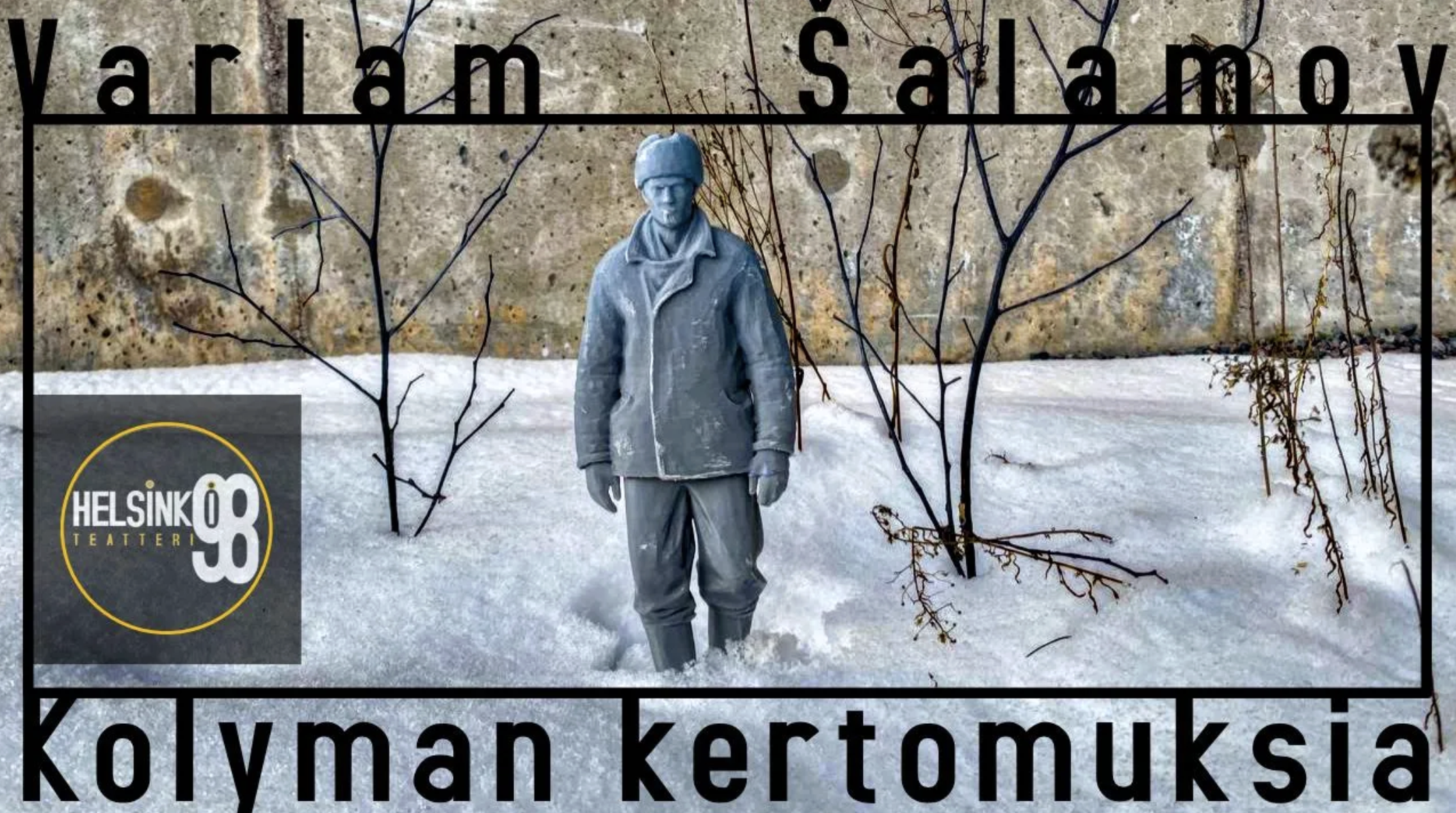
Kolyma Tales
A stage production based on the short story collection by Varlam Shalamov
Helsinki 98
Kolyma Tales is one of the most significant works of Gulag literature of the 20th century. Its author, Varlam Shalamov, spent nearly two decades in Soviet forced labor camps in Kolyma, in northeastern Siberia, where temperatures drop to –50°C. Out of these experiences emerged a dense, stripped-down and uncompromising body of prose — a work that does not explain or moralize. It bears witness.
"Hiroshima, Auschwitz and Kolyma are phenomena of the same scale."
Helsinki 98 brings to the stage a selection of stories from Shalamov’s major work, depicting life in the Kolyma camps: cold, hunger, labor among crushed stone — and moments where humanity disappears or unexpectedly flickers into view. What remains of a person when their humanity has been taken away? The performance does not aim at historical reconstruction, but at linguistic precision and theatrical clarity. How does Shalamov’s stark, tangible prose transform into theatre?
With the collapse of the Soviet Union in the late 1980s and early 1990s, previously banned authors were widely read in Russia — among them Varlam Shalamov and Aleksandr Solzhenitsyn. The latter became internationally renowned, while Shalamov, sometimes referred to as the “Dostoevsky of the 20th century,” remained in the shadows.
Varlam Shalamov (1907–1982) was a principled and contradictory figure. Millions were sentenced to labor camps on arbitrary grounds, yet he was convicted under one of the harshest political charges: “Trotskyist counter-revolutionary activity.” In 1929, as a student, he distributed Lenin’s so-called Testament, which criticized Stalin. Today, he might be described as a dissident.
Shalamov spent approximately 17 years in the archipelago of prison camps, mostly under the extreme conditions of Kolyma. He consistently refused positions of authority in the camps, as they would have required violence against fellow prisoners. “No, I will not become a foreman — I would rather die.” His survival was a matter of chance and endurance: during his final years in the camps, he was assigned work as a medical orderly, which ultimately saved his life.
After his release in 1953, Shalamov began writing poetry and his major work, Kolyma Stories. He devoted his life to it, but it was not published in the Soviet Union during his lifetime. Abroad, however, it appeared in unauthorized editions in the 1970s (to protect the author), and in 1981 he was awarded the Freedom Prize by the French PEN Club. Shalamov died in 1982, poor, forgotten, and nearly deaf and blind, in a psychiatric hospital. Kolyma Stories was finally published in the Soviet Union in 1989. The Finnish translation by Ulla-Liisa Heino was published in 1991.
"Precision and brevity are the first virtues of prose." — Varlam Shalamov
Helsinki 98 is a theatre collective founded in 2023, examining the role and meaning of art in the reality shaped after 24 February 2022. Over two and a half years, their seven productions have reached a total audience of 8,870.
Now Helsinki 98 brings this literary testimony of the violence of the Soviet system to the stage — as its Finnish and potentially European premiere — at the Helsinki 98 stage in Vuosaari, at Vuosaaren Tilajakamo.
Author: Varlam Shalamov
Finnish translation: Ulla-Liisa Heino
Director, producer: Director
Assistant director: Martti-Tapio Kuuskoski
Set design, lighting, video, poster: Pavel Semchenko
Sound design: Samuli Kivelä
Costume design, stage management: Anis Kronidova
Performers: Sami Lanki, Juha-Pekka Mikkola, Maksim Pavlenko
Production and marketing: HELSINKI 98
Duration: approx. 1 h 40 min (no intermission)
Venue: Helsinki 98 stage, Vuosaari, Vuosaaren Tilajakamo
The production has been supported by the Arts and Culture Division and the Helsinki City Library and Culture Committee.